


Map awareness under pressure
Map awareness is a rhythm you practice, not a talent you either have or do not. This guide builds that rhythm for messy ranked pubs.
Map awareness is a rhythm, not a talent
People say "just look at the minimap" as if that were a personality trait some players are born with and others are not. It is not a talent, it is a rhythm, and rhythms are built through repetition the same way a jump shot or a piano scale gets built. If you only glance at the map when you are bored between last hits, you will glance too late every time something actually matters, because the moments that matter are exactly the moments you are busy focusing on your own hero model.
Build an internal timer: every few seconds, eyes down to the minimap, then immediately back up to the fight or the lane in front of you. It sounds mechanical and slightly ridiculous to practice deliberately. It works anyway, the same way deliberately practicing scales feels robotic right up until you can play without thinking about it. This habit pairs directly with ward vision and cooldown tracking, because awareness without information is just anxiety, and information without the awareness to actually look at it is wasted gold sitting on the map doing nothing.
The reason this matters more in pubs than in coordinated team play is simple: nobody is going to call rotations for you over voice comms in a silent queue. Your own eyes are the entire information pipeline, and if that pipeline runs on a schedule of "whenever I happen to remember," you are playing with a permanent handicap compared to anyone who has built the habit into muscle memory.
Habits when you are behind
When you are down gold and experience, the map becomes more important, not less, and this is exactly backwards from how most pub players actually behave under pressure. Behind players chase for "one fight" that will fix everything, tunnel visioning on a kill that will not actually change the game state even if it lands. Ahead players, by contrast, farm efficiently and take objectives calmly, which is precisely why the gap widens instead of closing.
Break the chase rule for yourself: if you do not currently see three of the five enemy heroes on the map, do not commit past the river unless you have an actual plan for the ones you cannot see. This single rule prevents a huge percentage of the double and triple deaths that turn a recoverable deficit into an unrecoverable one.
- Check the minimap before every spell cast that commits you forward into unknown territory.
- After any death, watch who is missing on the respawn timer before you walk the same path again.
- When your team smokes to engage, confirm you are not walking directly into vision the enemy already has.
- If you are farming the triangle while behind, know exactly which enemy heroes can physically reach you within five seconds.
- Resist the pull to "make something happen" through a risky solo play when the map shows no safe opening.
Being behind also means your margin for information error shrinks to almost nothing. A team that is ahead can survive one bad rotation call because their gold and level lead absorbs the mistake. A team that is behind gets punished immediately and often permanently for the exact same mistake, which is why the awareness habits above matter disproportionately more once you are already losing.
Habits when you are ahead
Being ahead flips the awareness priorities without removing them. The temptation when winning is to relax the minimap rhythm because "we are clearly better," which is exactly how a comfortable lead turns into a nervous throw. Ahead teams should be using map awareness to identify safe farming windows and objective timings, not just to avoid death, since the goal shifts from survival to conversion.
A common ahead-team mistake is splitting up to farm efficiently without tracking where the losing team's remaining resources are concentrated. A team down on gold and levels often has one or two remaining threats, usually a core who can still one-shot an isolated hero, and map awareness should specifically track that threat rather than assuming a lead means safety everywhere on the map.
Ahead teams should also use the map to time objectives rather than just avoiding fights. Knowing when the enemy's dangerous cores are visibly farming far from an objective is the signal to take that objective immediately, and missing that window because nobody was tracking enemy hero positions is a common way comfortable leads get stretched into unnecessarily long games.
Information gaps decide pubs
Most pub throws trace back to an information gap rather than a mechanical mistake or a bad item build. Someone farms deep in the jungle while four enemy heroes are missing from the map. Someone takes a contested rune fight without knowing whether the enemy mid's ultimate is available. Someone walks toward Roshan without checking whether the enemy has detection placed nearby. Close the gap before you click the action that commits you, because once the action starts, the information you needed thirty seconds ago no longer helps.
Official client settings on DOTA 2 let you enlarge the minimap and adjust hero icon visibility, and adjusting those settings costs nothing and takes five minutes. Do that before you spend money on any tool at all. If you still find yourself missing rotations after optimizing your own settings and building the glance habit, that is the point where map tools on features become worth evaluating rather than a shortcut you reach for first.
Information gaps compound across a team faster than most players expect. One player missing a rotation call often leads to a second player making a decision based on incomplete information passed along secondhand, and by the time a fight actually happens, the entire team is operating on a version of the map state that stopped being accurate two minutes earlier.
Tools versus skill
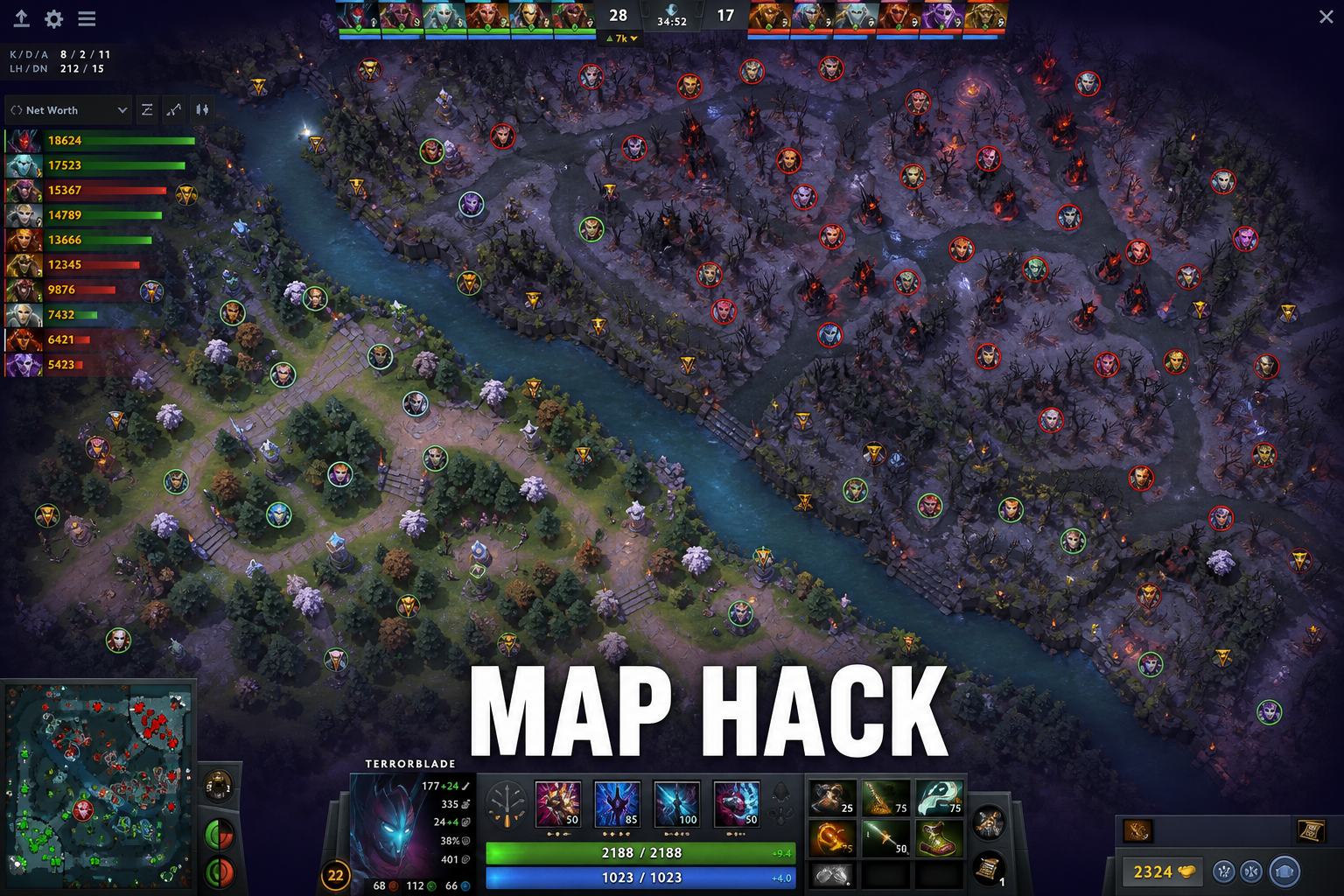
Map hack style overlays on DOTA2 Cheats show fog information that some experienced players already predict accurately through pattern recognition and habit alone. If you choose to use tools like this, the critical thing is keeping the glance rhythm intact regardless. A full map rendered on your screen does nothing for your decision making if your eyes never actually leave your own hero model to look at it, which is a real failure mode even among players running full map visibility.
The honest framing here is that tools remove the fog, not the discipline. Skill in this specific area is the habit of looking, interpreting what you see quickly, and acting on it before the window closes, and that skill has to be practiced regardless of what information source feeds it. Players who expect a tool alone to fix poor map habits are usually disappointed, because the overlay just makes the same undisciplined glance pattern slightly less punishing rather than actually fixing it.
For further reading on objectives and general game knowledge, Liquipedia covers patch history and objective mechanics in detail. Our resources hub collects setup guides and further reading in one place if you want to go deeper on any specific habit covered here.
Map awareness around Tormentors and outposts
Newer objectives on the map generate their own awareness responsibilities that pub players frequently forget to fold into their existing minimap rhythm. Tormentor camps sit off the main pathing routes, which means they require a deliberate glance check rather than the passive awareness that naturally comes from fighting near mid lane or the river. Build a habit of checking Tormentor status specifically around the time windows when it becomes available, rather than only remembering it exists after the enemy team has already secured the reward.
Outposts change vision and experience flow constantly throughout a match, and awareness of who currently controls each outpost tells you a surprising amount about likely rotation paths for both teams. A team that recently lost control of an outpost near their own jungle is signaling a vulnerability in that area, and an aware opponent treats that signal as an invitation to apply pressure precisely where the outpost changed hands.
Map awareness during a split push
Split pushing creates a specific awareness challenge for both the pushing player and the team defending against it, since both sides need to track hero positions across a wider effective map area than a standard grouped game requires. If you are the one split pushing, your awareness job centers on tracking teleport scroll cooldowns and Buyback status on the heroes most likely to be sent to stop you, since getting caught alone by a hero who should not have been able to reach you in time usually traces back to a missed cooldown or Buyback read.
If you are defending against a split push, awareness needs to track not just the pushing hero's location but also what the rest of their team is doing simultaneously, since a well-executed split push often pairs with a separate play elsewhere on the map designed to punish whichever response your team chooses. Splitting your attention correctly between the immediate threat and the broader map state is the actual skill being tested, not just the ability to notice a lone hero pushing a lane.
Common map awareness mistakes by MMR bracket
Herald and Guardian games typically show almost no minimap glancing at all, with players focused entirely on their own hero and immediate surroundings for the full length of most games. The single highest value change at this bracket is simply starting the glance habit, even at an imperfect and irregular interval, since any awareness at all outperforms none.
Crusader and Archon players glance at the map but often fail to act on what they see, noticing a missing enemy hero without adjusting their own positioning or risk tolerance in response. Legend and Ancient brackets generally react correctly to obvious information but miss subtler signals like outpost control changes or unusual farming patterns that hint at a coming play.
Divine and Immortal pubs show strong individual awareness but occasionally suffer from overconfidence in read accuracy, committing to a play based on a map read that was correct thirty seconds ago but has since changed due to a rotation the player did not catch in the intervening time.
Putting the whole awareness habit together
Map awareness is not one skill, it is a stack of small habits reinforcing each other: a consistent glance rhythm anchored to a game event, specific checklists for lane phase and teamfights, honest tilt recognition, and role-appropriate priorities. None of it works in isolation from vision and cooldown tracking either, since awareness without information from ward vision and cooldown tracking is just staring at an empty map on schedule. Build the rhythm first, then layer the other habits on top, and pub games start feeling considerably less random than they used to.